Shorebirds
Easy Ways to Tell Shorebirds Apart
If you’ve ever stood on the shoreline watching a cluster of small, fast-moving birds and thought, “They all look the same”, you’re not alone. Shorebirds can sometimes be tricky to identify. They’re often similar in size and shape, many share the same muted colors, and move quickly.
But once you know what to look for, these small differences jump out like bright shells on the sand. Here are the easiest, most reliable clues to help you tell common shorebirds apart, even if you’re brand new to bird watching.
Start With Size: Tiny, Medium, or Tall
Size is the quickest shortcut to identifying a shorebird.
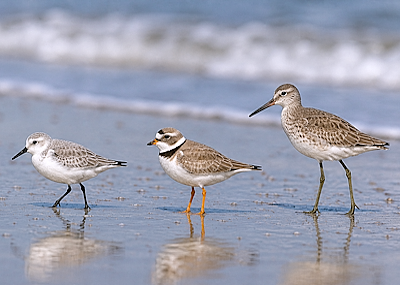
Before you even look at colors or patterns, just notice how tall the bird is. Tiny birds like Sanderlings and Semipalmated Sandpipers are about the size of a smartphone. Plovers and Ruddy Turnstones fall into the medium category. They have rounder bodies, shorter legs, and just feel a bit more solid. And then there are the tall ones: Willets, Yellowlegs, and other long-legged waders that stride through the shallows like they own the place.
Once you start paying attention to height alone, you’ll be surprised how quickly the puzzle pieces fall into place.
Bill Length and Shape
A bird’s bill is one of the most reliable clues you’ll ever use. Plovers have short, stubby bills, perfect for pecking in the sand for insects and tiny crabs. Sandpipers tend to have straight, medium length bills made for probing the sand and mud. A Godwit’s bill is slightly upturned, Curlews and Whimbrels curve downward, and Yellowlegs have long, straight bills that look built for serious probing.
This one’s pretty easy to spot once you notice it. Even subtle differences can help separate similar birds.
Leg Color: A Surprisingly Helpful Detail
You don’t need binoculars to notice leg color, and it’s often a dead giveaway. So, it can be surprisingly helpful, especially from a distance. Yellowlegs, of course, have bright yellow legs. Sanderlings and Semipalmated Sandpipers have black legs. And Ruddy Turnstones and some plovers sport orange ones.
Here’s a pro tip: If you see a tiny bird sprinting back and forth with the waves and it has black legs, there’s a good chance it’s a Sanderling.
Watch the Way They Move
Behavior is one of the easiest ways to separate look-alikes. Movement patterns can be so distinct that many bird watchers recognize the bird before they even raise their binoculars.
Sanderlings are the classic wave chasers, running in and out with the surf like tiny wind-up toys. Plovers use a stop?and?start hunting style: run, freeze, stare, peck. Willets walk with slow, deliberate confidence. Turnstones, true to their name, flip shells and seaweed like they’re investigating a mystery.
Notice the Body Shape
Even birds of similar size have different outlines. Plovers have round heads, big eyes, and short bills. They have that “adorably cute” look. Sandpipers are sleeker and more streamlined. Willets are tall and straight-backed. Turnstones are compact and barrel-chested.
Try watching them in silhouette at sunset, the differences pop even more.
Field Marks: The Little Details That Matter
These are the little details that make a big difference.
Some birds come with built?in “fashion statements.” Semipalmated Plovers wear a bold black neck ring. Willets flash dramatic black?and?white wings when they take off. Ruddy Turnstones have a tortoiseshell pattern that looks hand?painted. And many sandpipers transform in spring, turning rusty, golden, or speckled.
You don’t need to memorize every mark - just notice what stands out.
Listen for Their Calls
Even a simple “peep” can be a clue.
You don’t need to be a “bird call person” to pick up a few easy sounds. Willets shout a loud, ringing “pill?will-willet!” Yellowlegs give clear sharp whistles. The Greater Yellowlegs gives three notes, the Lesser gives one or two. And the Sanderlings make soft, high “pip-pip” sounds as they run.
You don’t need to be an expert - just noticing pitch and rhythm can help narrow things down.
Consider the Habitat
Where a bird chooses to stand tells you a lot about who it is. Sanderlings love the surf line. Plovers prefer the drier upper beach. Yellowlegs and Willets hang out in marshes, tidal flats, and shallow pools. Turnstones gravitate toward jetties and rocky edges.
Birds pick their spots based on their feeding style, so their habitat is a built-in clue.
Use the “Rule of Three”
When you’re unsure of the species of a mystery bird, check these three things first:
1. Bill shape
2. Leg color
3. Behavior
These three clues alone will solve most of your ID questions on a typical beach day.
If you’re having trouble identifying a bird, don’t stress over it. Even experienced bird watchers mix up sandpipers. The goal isn’t perfection - it’s noticing patterns, enjoying the beach, and slowly building your “shorebird eye”.
Shorebird identification isn’t about memorizing every species. It’s about learning what to notice. The more time you spend watching them, the more their quirks and personalities stand out. Before long, you’ll be pointing out Willets and Turnstones like old friends.